Why do we need to carry out Harmonic Distortion Assessments for new connections?
A harmonic assessment is required by Network Operators for new generation, storage or distribution connections to ensure compliance with the following standards:
-
ENA EREC G5/4, ENA EREC G5/5 (for connections in the UK)
- IEC 61000-3-6 (for connection at MV, HV, and EHV in Europe)
The Effects of Harmonics in Power Systems
Harmonic levels on the network are at an all-time high. Ideal current and voltage waveforms will be sinusoidal in nature and in the UK will be at a frequency of 50Hz. Harmonics manifest as distortion from a perfect sinusoidal wave. While most equipment will tolerate to an extent an imperfect supply, harmonics can cause many issues on the power system, including:
- Increased equipment losses. These additional losses can lead to overheating of equipment and subsequent failure. Generators, transformers and cables are particularly susceptible to overheating.
- Excitation of a network resonance, which can lead to system oscillations and instability.
- Interference with protective relays, metering, control and communication devices.
Harmonic Analysis
For connection offers made prior to 2020, harmonic assessments were required following guidance in EREC G5 Issue 4 (G5/4). Detailed assessments involved modelling a significant proportion of the distribution/transmission system around the new generation, distribution or storage site. Following network model validation, inclusion of measured background distortion and the production of a harmonic model of the new site, harmonic load flows were conducted for several ‘legitimate’ network configurations. At the Point of Common Coupling (PCC), the total voltage distortion was computed and compared with planning limits. The standard also called for further assessment of remote nodes in the vicinity of the new connection, to ensure that existing sites were not pushed beyond planning limits due to the new connection. Since 2020, following the release of EREC G5 Issue 5 (G5/5), the assessment process has changed quite drastically, with the introduction of site-specific distortion limits and impedance loci (utilised by most Network Operators). The new standard requires many more harmonic load flow simulations, across a broader range of network impedances. Following receipt of this harmonic specification from the Network Operator, the assessment will broadly follow these steps:
- Create an equivalent model of the new site suitable for harmonic assessment, including all primary equipment such as cables, transformers (with harmonic frequency dependencies), and the non-linear active sources with harmonic current injection profiles.
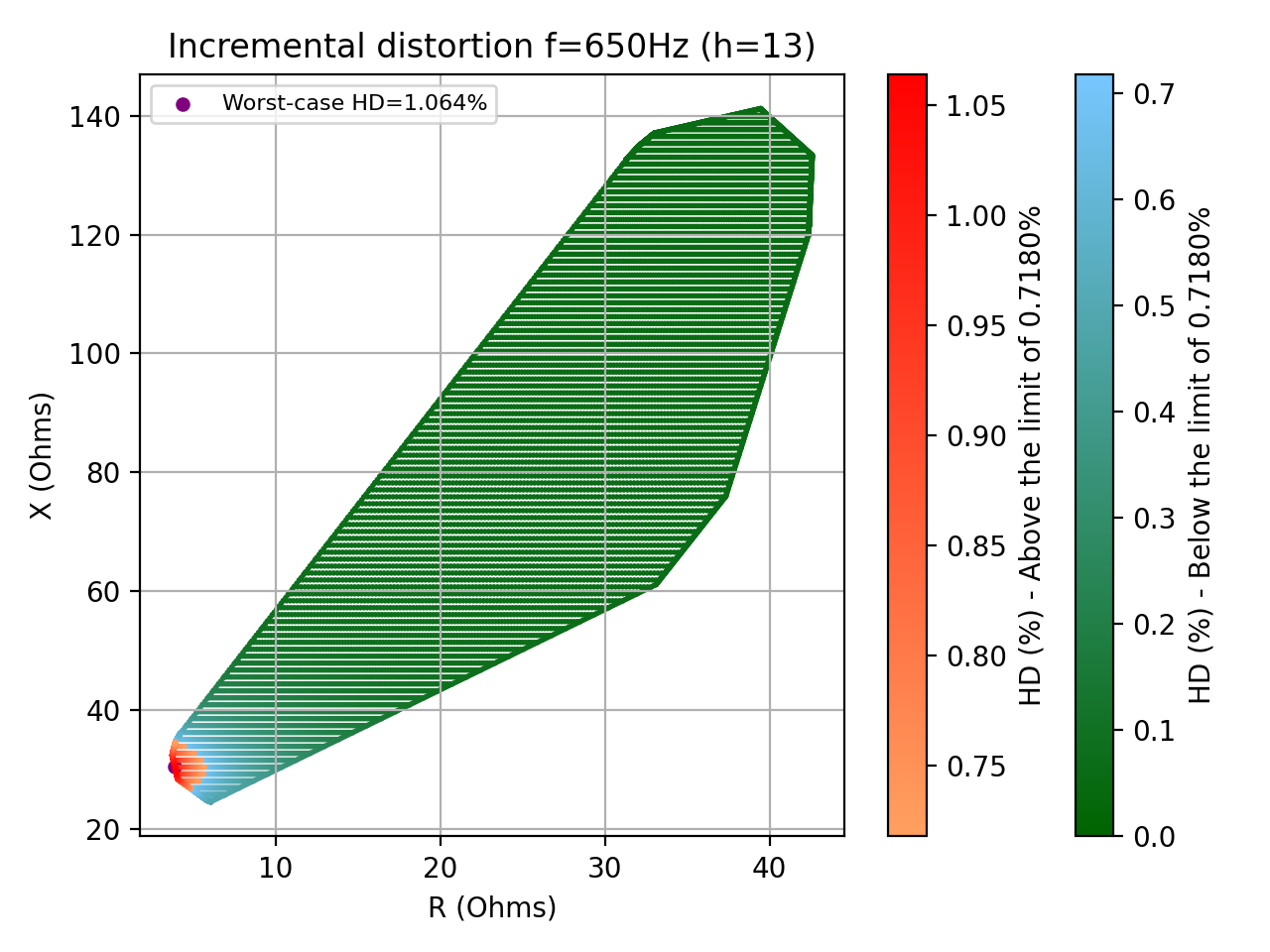
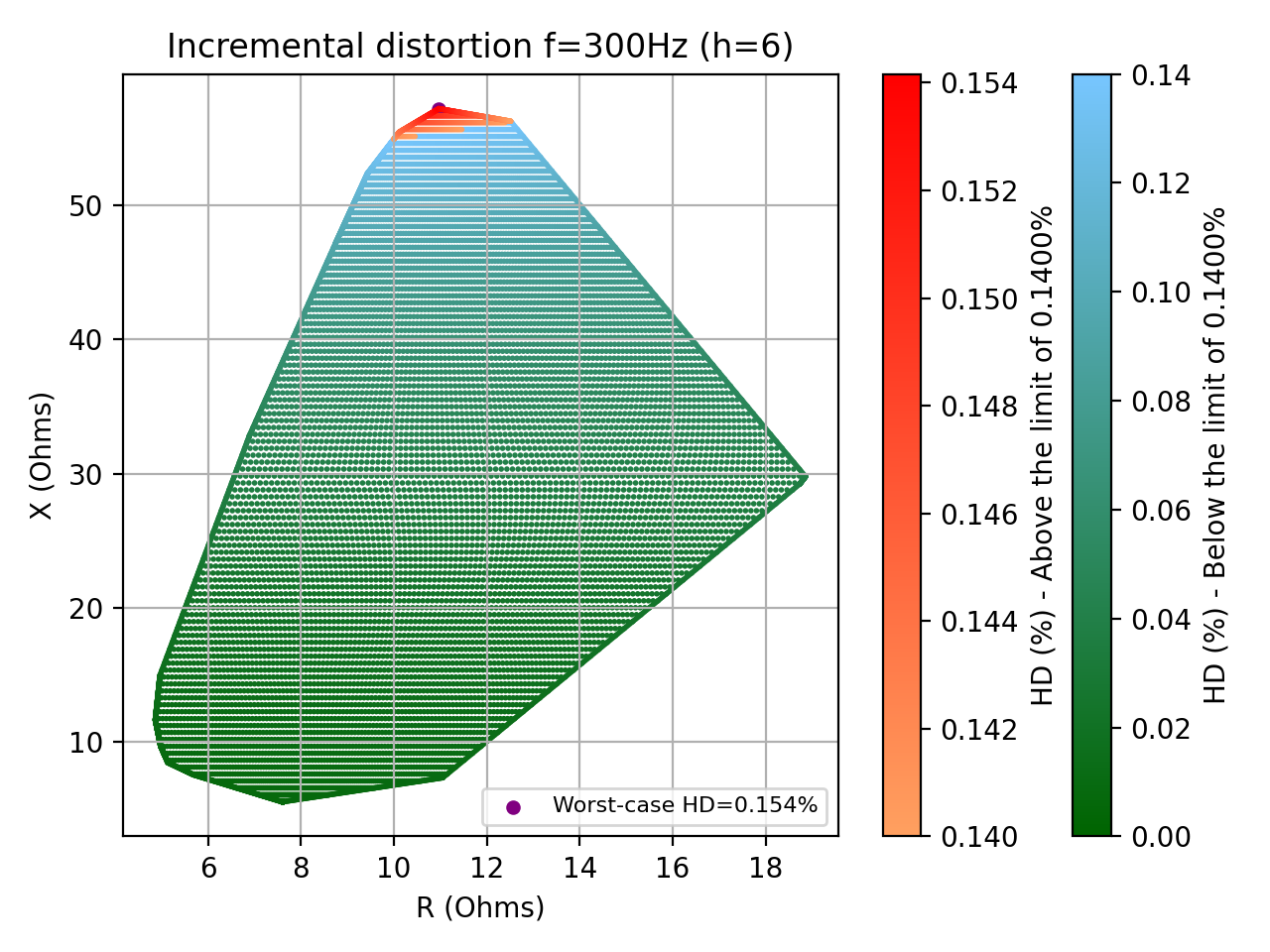
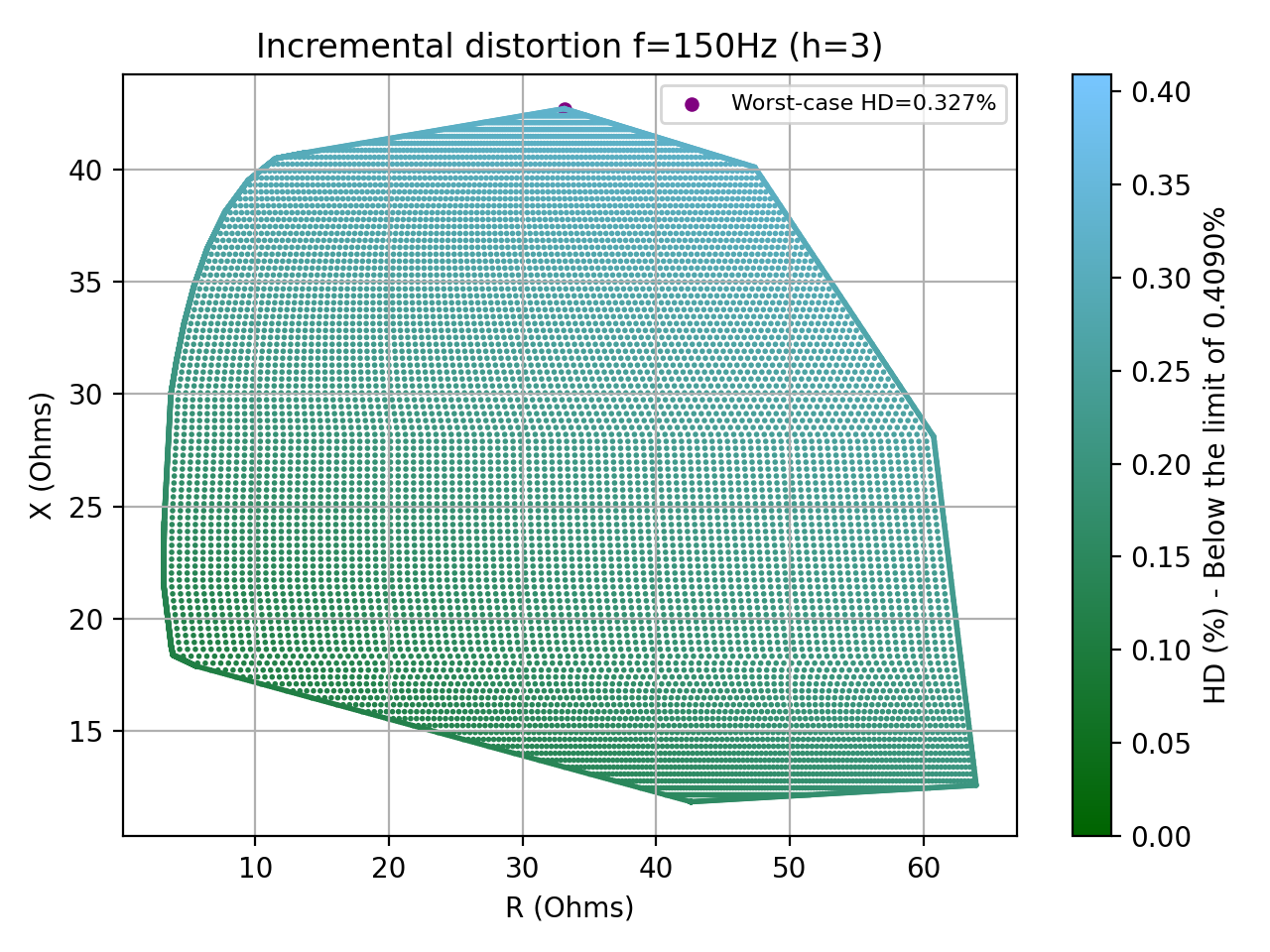
- Extract harmonic impedance loci (from the harmonic impedance profile provided by the Network Operator) and setup the boundaries defining the limits of R and X values at the PCC for harmonics up to the 100th order. The impedance loci are prepared by calculating the driving point impedance at the PCC for all ‘legitimate’ network configurations for harmonic orders 2-100. After these R and X points are calculated, the final step is to join the outer points to form a polygon. There are various methods to achieve this.
- Calculate the incremental voltage distortion at the PCC and compare against allocated incremental limits. Incremental distortion includes harmonic emissions from the new site only.
- Calculate the total harmonic voltage distortion at the PCC and compare against allocated total distortion limits. Total distortion includes the effects of the new site and existing background distortion, including amplification of the existing distortion.
- Recommend mitigation techniques if harmonics exceed acceptable limits.
Mitigating Harmonic Distortion
PSE 2 can assist with mitigation of harmonic non-compliance. Mitigation options include:
- Active harmonic filters.
- Passive harmonic filters; most commonly a C-type filter connected at MV.
- Reduction of the export capacity.
- Reconfiguration of the site.
- Negotiation of an impedance loci review with the Network Operator. At PSE 2, our custom algorithms lead to the production of heat maps, which can be reviewed by the Network Operator. Regions of failure can be easily observed, providing the Network Operator with the opportunity to refine the loci, if for example the regions of failure are related to illegitimate operating points.
- Some Network Operators are permitting the use of ‘live’ harmonic monitoring, allowing the site to be connected and exporting/importing. The site would be expected to react to breaches of the limits within a 10-minute rolling average.
Predicting harmonic non-compliance is now very challenging without first obtaining the harmonic specification from the Network Operator, including existing background distortion, allocated incremental and total limits, and impedance loci. However, certain measures can be taken during the design stage, such as:
- Choosing cables with lower capacitance to help mitigate resonance effects, particularly in sites with long circuits, such as PV farms. Keeping cable runs as short as possible also has the same effect.
- Selecting inverters with lower harmonic current contributions and/or built-in mitigation technologies, such as complementary switching, which enables mutual cancellation of harmonic currents between inverters.
- Given the more onerous assessments, sites are advised to push inverter manufacturers for more detailed harmonic models, generally comprising Norton or Thevenin equivalent models.
It is strongly recommended that the site-specific harmonic specification is requested as early as possible. This approach allows the study to commence early in the project schedule and as such any identified harmonic non-compliance issues can be dealt with up front, without a major impact on the project schedule.
Get in touch with our experts at PSE 2 Consulting today to discuss your Harmonic Assessment needs.